First-timers
Watching your first bout
What to watch for at your first Muay Thai card: the eight limbs, the roundhouse kick and the shin check, the push-kick, elbows, knees, the clinch and scoring.
Choose a night at the ring ↗Quick answer
Watch the legs and the clinch. Muay Thai strikes with fists, elbows, knees and shins, and its signature moves are the roundhouse kick swung from the hips, the shin raised to check it, the push-kick that keeps an opponent away, and knees and elbows from the clinch, where fighters stay locked together. Under the IFMA rules only clean, unblocked strikes score. Between rounds, keep an eye on the corners.
The eight limbs
Muay Thai is Thailand's full-contact striking art, and it also allows sweeps and clinching. Its nickname, the Art of Eight Limbs, comes from the four pairs of weapons: fists, elbows, knees and shins. Almost every technique uses the whole body, with the hip rotating into each kick, punch, elbow and block. Fighters stand with the back leg only a little behind, roughly shoulder width apart, a narrower base than a boxer's, because the legs are weapons and shields as much as a platform to punch from.
Kicks and the shin check
The two kicks you will see most are the thip, literally a foot jab, and the roundhouse kick, which draws its power almost entirely from the rotation of the hips, often with the arms swinging the other way for extra torque. Thai fighters are trained to land with the shin, not the foot, because the foot, with its many fine bones, is much weaker. When a roundhouse kick comes in, the defender usually checks it, raising the outside of the lower leg to meet it. Listen for the crack of shin on shin.
The push-kick
The teep, the push-kick, is thrown straight out from the hip like a jab with the foot. It is mainly defensive: fighters use it to control the distance, to stop an opponent's rush or to block an attack before it lands. Thrown quickly and hard enough, it can knock an opponent off balance. A fighter who keeps landing the teep is often the one controlling the range, even if the bigger strikes are coming from the other corner.
Elbows
Elbows come in many shapes: across, rising or falling on a diagonal, upward like an uppercut, straight down, spinning backwards and even flying. Fighters reach for them when they are too close to throw a hook. Swung in from the side, an elbow can open a cut above the eye and let blood run into the opponent's sight. Wikipedia rates the elbow as the sport's most dangerous strike, and a clean one can bring a knockout, which is why the crowd erupts when one lands.
Knees and the clinch
A Western boxing referee pulls clinching fighters apart; in Muay Thai they are left locked together, and that is where much of the knee and elbow work happens. In the front clinch a fighter cups his hands behind the opponent's head, forearms pressing on the collarbone, and drives knees into the body or head. You may also see the arm clinch, the side clinch and the low clinch. Knees come in many forms, from the straight knee to the jumping knee and the flying knee, thrown off one leg.
How a bout is scored
Under the IFMA rules, a strike counts only if it lands without being blocked. A blow that meets the opponent's glove, forearm, shin or foot does not score, so a well-guarded fighter can absorb a flurry without losing points. If a bout goes the distance and the fighters finish level, the IFMA rules award it to the one who landed more full-contact blows. Professional cards also end early when a fighter is stopped, so watch the referee as closely as the fighters.
Between rounds and the music
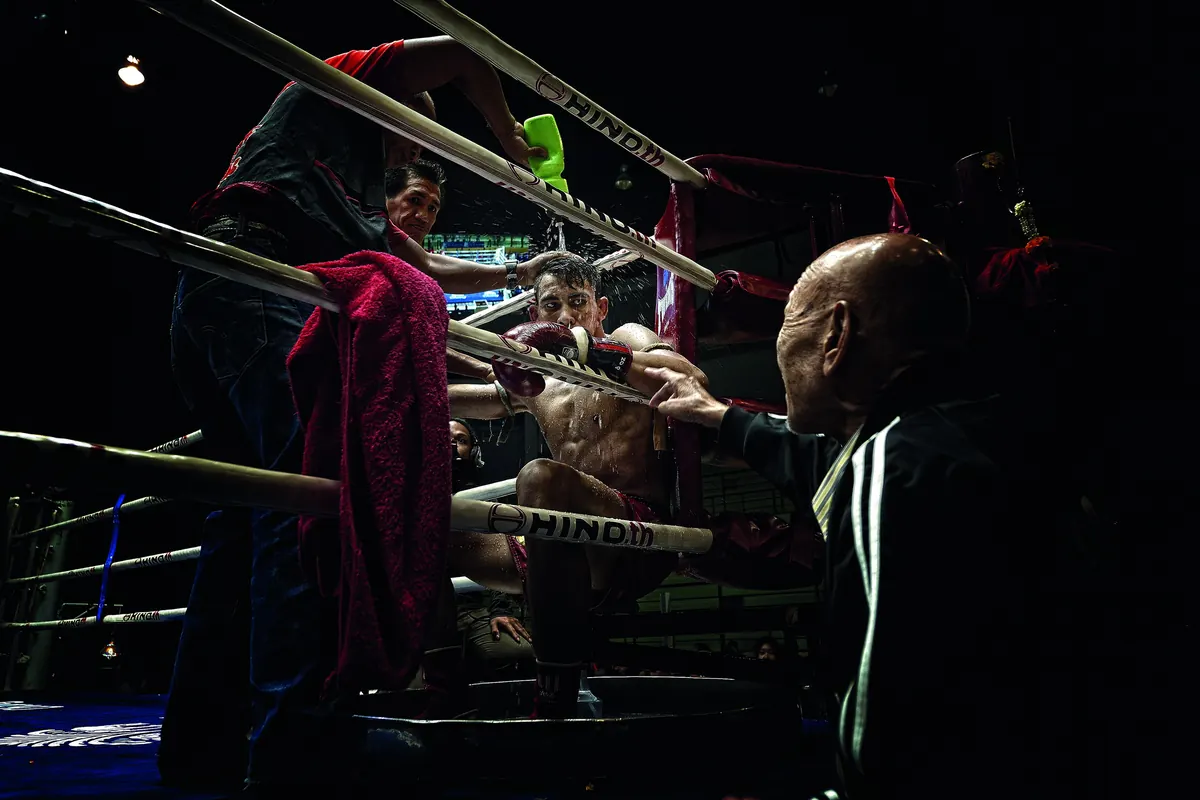
When the bell rings, watch the corners. Trainers lean through the ropes to work on their fighter in the short break, and the corner where the headband was placed for luck at the start is the same one. Listen too. Muay Thai is unusual among kickboxing sports for its music: the boxing music played on reed pipe, drums and cymbals rises in tempo with the action, so the arena often tells you a bout is heating up before the scoring does.
Read next: The rituals around a bout
Sources